


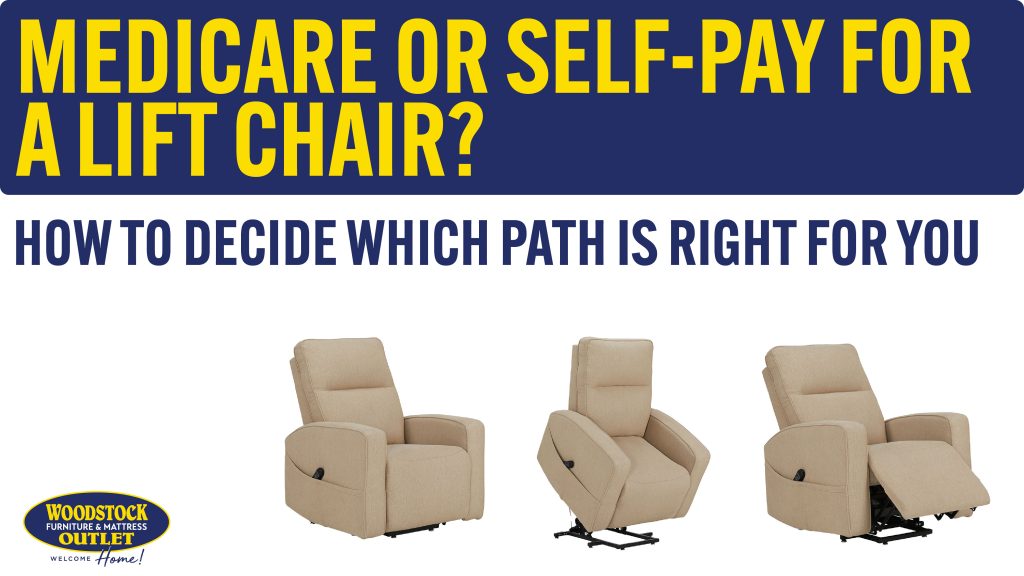
If you’re shopping for a lift chair, you may be wondering whether you should pursue Medicare coverage or simply purchase the chair yourself. At first glance, the answer may seem obvious. After all, why wouldn’t you seek financial assistance if Medicare might help? In reality, the decision can be more complicated.
Medicare may help cover part of a qualifying seat-lift mechanism for shoppers who meet its strict medical requirements. However, Medicare does not pay for the upholstered chair, reclining functions, comfort features, or most of the total purchase price. The Medicare claims process also requires medical documentation and limits you to stores that are eligible Medicare-enrolled durable medical equipment suppliers.
By contrast, self-pay is a much more direct path that gives you greater freedom to shop for the chair that best fits your body, home, style, budget, and comfort preferences. However, you are responsible for the full purchase price.
So, which path is better?
Well, that depends on your medical situation, financial priorities, preferred chair features, delivery timeline, and your willingness to complete Medicare’s required process. In this short guide, we’ll explore whether Medicare coverage may be realistic for you, compare the potential advantages and disadvantages of both paths, and help you decide the best next steps for you. By the end, you’ll be one step closer to all the functional benefits a lift chair can provide for you or your loved one.
[Important disclaimer: As of publishing of this article, Woodstock Furniture & Mattress Outlet is not a Medicare-enrolled durable medical equipment supplier. Lift chairs purchased from Woodstock Furniture & Mattress Outlet should be treated as self-pay purchases. We cannot bill Medicare, submit a lift-chair claim on your behalf, complete medical-necessity documentation, or guarantee reimbursement. This article is intended to provide general educational information and does not constitute professional medical, insurance, billing, legal, or financial advice.]

What Are Your Two Main Lift-Chair Purchasing Options?
Most shoppers considering Medicare assistance have two basic paths:
Option 1: Pursue Medicare Coverage or Reimbursement
Under this path, you work with the healthcare practitioner treating your condition, Medicare or your Medicare Advantage plan, and an eligible durable medical equipment supplier. If you meet Medicare’s strict medical and documentation requirements, Medicare Part B may help pay toward the approved cost of the seat-lift mechanism inside the chair.
If your claim is approved and your deductible has already been met, Medicare typically pays 80% of the cost of the seat-lift mechanism only. The remaining 20% of the seat-lift mechanism and the rest of the chair is generally your responsibility.
Option 2: Purchase Your Lift Chair through Self-Pay
Under the self-pay path, you purchase the lift chair without seeking any sort of Medicare coverage, payment assistance, or reimbursement. You are able to choose the retailer, specific lift chair model, features, upholstery, delivery options, and payment method.
Going this route means that there is no Medicare medical-necessity review or DME claim to process. However, you are responsible for the chair’s full price.
Since we are not enrolled with Medicare as a durable medical equipment supplier at this time, lift chairs sold by Woodstock Furniture & Mattress Outlet are available on a self-pay basis only.
What Do We Mean by “Self-Pay”?
Self-pay does not necessarily mean paying with cash. It simply means that Medicare is not paying toward the purchase and the retailer is not submitting the chair through Medicare’s durable medical equipment process.
Depending on the retailer and your own unique circumstances, self-pay options typically include any and all payment methods typically found at furniture stores, including payment types accepted here at Woodstock Furniture & Mattress Outlet. This includes:
- Cash
- A debit card
- A credit card
- Financing options (including our own interest-free financing)
- Short-term BNPL (“buy now, pay later”) financing
- No-credit-needed payment options (lease-to-own)
Shoppers also occasionally ask whether they can use a HSA (health savings account), flexible spending account, or similar tax-advantaged account to pay for their lift chair. Eligibility can depend on the account, the item, and the shopper’s circumstances, but often requires additional documentation like a Letter of Medical Necessity (LMN). For this reason, shoppers should always confirm this first with their plan administrator or with a qualified tax professional.
The Medicare Coverage Route: Pros, Cons & Considerations
First, let’s start with our discussion of lift chairs and Medicare.
Are you eligible? What is covered? And what does the process look like anyway?
Do You Qualify for Medicare Lift-Chair Coverage?
The truth is that only Medicare, your Medicare Advantage insurance plan, and your professional medical care team can determine whether a claim qualifies. Before going any further down the Medicare lift chair funding rabbit hole, it’s important to first confirm that you or your loved one qualifies to begin with.
However, the following questions can help you decide whether the Medicare path may be worth exploring. Ask yourself:
- Do I have severe arthritis of the hip or knee or a severe neuromuscular disease?
- Am I completely unable to stand from a regular armchair or another chair in my home?
- Can I walk after the chair helps me reach a standing position?
- Have other appropriate treatments, such as medication or physical therapy, been tried without allowing me to stand from a chair?
- Is the seat-lift mechanism part of my treating practitioner’s plan of care?
- Does my treating practitioner believe it is medically necessary?
- Am I willing to seek out a Medicare-enrolled medical equipment supplier that meets Medicare or my insurance plan’s requirements?
- Am I prepared to complete the required medical and insurance paperwork for Medicare assistance?
Medicare’s current seat-lift coverage policy generally requires each of the key medical conditions to be met. Simply having trouble standing, struggling with a low sofa, or receiving a prescription does not automatically qualify someone.
For a more detailed explanation of the requirements and process, see our companion guide, Does Medicare Pay for Lift Chairs? What Shoppers Need to Know.
Understanding the Medicare Claim Process for Lift Chairs
As outlined by Medicare Part B, eligible lift chairs are considered “durable medical equipment” or DME. While the exact process for filing a lift chair claim can vary depending on whether you have an Original Medicare or Medicare Advantage plan, you should expect to go through the following ten steps:
- Speak with the practitioner treating the condition that affects your ability to stand.
- Determine whether your condition appears to meet Medicare’s coverage criteria, and if so, make sure this need is documented in your medical record.
- Obtain the required written order from your treating medical practitioner.
- Contact Medicare or your Medicare Advantage plan.
- Find an eligible durable medical equipment supplier in your area.
- Confirm whether the supplier accepts Medicare assignment.
- Complete any additional plan-specific authorization or documentation requirements.
- Shop eligible lift chairs and make your selection.
- Ask your supplier for a breakdown of covered and noncovered costs.
- Allow the supplier to submit the appropriate claim during the check-out process.
The Centers for Medicare & Medicaid Services (CMS) requires supporting medical records, a standard written order, supplier documentation, and proof of delivery for all seat-lift claims. Because Woodstock Furniture & Mattress Outlet is not a Medicare-enrolled DME supplier at this time, we cannot complete this process for lift chair purchases made through our stores.
Potential Benefits of Lift Chair Medicare Claims
For shoppers who qualify, the main advantage of pursuing a Medicare claim to help pay for their lift chair is purely financial. Under Original Medicare, Part B generally pays 80% of the Medicare-approved amount for covered durable medical equipment after the applicable deductible has been met. The shopper is usually responsible for the remaining 20% when the supplier accepts assignment.
Remember that this does not mean Medicare pays 80% of the chair’s retail price. The possible benefit applies only to the approved amount for the qualifying lift mechanism itself. Paying for the chair frame, upholstery, reclining functions, comfort upgrades, and other noncovered portions of the lift chair remain the shopper’s responsibility.
Still, for someone on a tight budget who appears to meet all of the medical criteria, even partial assistance may be worth pursuing.
A Medicare Claim May Be Worth Exploring When:
- You appear to meet all medical requirements.
- Your treating practitioner supports the need.
- Reducing your out-of-pocket cost is a major priority.
- You do not have a strong preference on chair brand, fabric, or style.
- You are willing to complete the Medicare documentation process.
- You understand that coverage is not guaranteed.
- You are comfortable waiting until the necessary steps are completed before making your purchase.
Potential Drawbacks of Lift Chair Medicare Claims
The Medicare path may provide financial help, but it can also significantly limit your options.
Strict Medical Eligibility
Medicare does not cover seat-lift mechanisms simply because they are helpful, convenient, or safer for a shopper. You must meet specifically outlined medical requirements, and the need must be supported by your treating practitioner’s records.
Limited Store Choice
You can only purchase from a supplier that is enrolled in Medicare and meets the applicable billing requirements. This limits the stores that you’re able to shop with.
Medicare provides an online medical-equipment supplier directory for shoppers who want to locate participating sellers. Just put in your ZIP code and type "seat lift mechanisms" in the field titled "equipment". Medicare Advantage shoppers may also be required to use a seller within their plan’s network. Depending on where you live, this may also require shoppers to travel further than their local furniture store if a Medicare-enrolled supplier isn’t close by.
More Paperwork
As discussed above, filing a Medicare Part B claim for durable medical equipment is a lengthy process requiring a written order or prescription, supporting medical records, appropriate supplier documentation, and proof of delivery. A doctor’s prescription by itself is not enough on its own.
Much Longer Process
Scheduling doctor’s appointments, requesting written orders, calling Medicare or your Medicare Advantage plan with insurance questions, and investigating supplier requirements almost always takes longer than buying directly through a furniture retailer. For this reason, it is best to begin your investigation into Medicare coverage long before your need for a lift chair arises.
Less Freedom to Choose
Since you are limited to eligible Medicare-enrolled sellers only, you’re also limited by what options they carry. Your DME supplier may carry fewer lift chair models, fabrics, brands, sizes, or comfort features than a traditional furniture store. This will vary by supplier, but shoppers should not assume every style or feature will be available through the Medicare path.
No Guarantee of Payment
Even when a shopper and practitioner believe the chair is needed, there is a possibility that the Medicare claim may still be denied if the documentation or coverage requirements are not satisfied. While an appeals process exists, this can also drag out the process.
Limited Financial Benefit
Finally, it’s important to remember that Medicare only covers up to 80% of the seat-lift mechanism’s cost, not the cost of the complete lift chair. Depending on the chair’s price and the approved amount, the financial assistance may represent only a small portion of the total purchase.
The Self-Pay Route: Pros, Cons & Considerations
Now let’s take a look at the pros, cons, and buying process for shoppers looking to self-pay.
Potential Benefits of Lift Chair Self-Pay
Self-pay gives you much more control over the entire purchase process, letting you shop lift chairs on your terms. As a result, you do not need to establish medical necessity, wait for a claim decision, or restrict your search to Medicare-enrolled suppliers. You can buy what you want, where you want, when you want, and from whom you want.
A Wider Lift Chair Selection
Furniture retailers will often offer far more choices in:
- Lift chair brands
- Different lift chair sizes
- Seat heights and depths
- Different weight capacities
- Upholstery materials
- Upholstery colors and patterns
- Reclining positions
- Motor configurations
- Headrest and lumbar functions
- Heat or massage features
- Price ranges
This can be especially important because a lift chair is ultimately still a piece of functional furniture that may be used for hours each day.
The Ability to Test Chairs In Person
A chair that looks suitable online may not fit the user’s body. Not all Medicare-enrolled DME suppliers have a large showroom that will allow you to see all available models.
Shopping in person at a traditional brick and mortar furniture store allows you to compare and assess:
- Seat height
- Seat width

- Seat depth
- Back and lumbar support
- Head and neck support
- Ease of getting in and out
- Footrest length
- Control placement
- Lift angle
- Reclining comfort
- Additional comfort and convenience features
A Simpler, More Familiar Process
With the self-pay route, there is no Medicare eligibility review or medical claim to worry about. Rather, the process will be just like any other time you’ve gone to a store to buy a new sofa or recliner. Once you have selected a lift chair, reviewed the retailer’s policies, and chosen a payment method, the purchase (and delivery) can move forward.
Greater Control Over Timing
A shopper who needs a chair very soon may prefer not to wait while records and insurance requirements are requested and reviewed. The truth is, for many customers who come into our stores shopping for lift chairs, they are looking to fill an immediate or near-immediate need.
While availability and delivery timeframe will still vary by retailer and product, the purchase is not dependent on Medicare approval. For this reason, shoppers who opt for self-pay are typically able to get the lift chair they need delivered much sooner than the alternative.
Greater Control Over Features
Under self-pay, you get to decide which features matter enough to purchase. You are not limited to what Medicare may consider medically necessary.
Do you want heat and massage? Performance upholstery? USB charging for your devices? It’s all up to you.
Potential Drawbacks of Lift Chair Self-Pay
The main disadvantage is straightforward: you are responsible for the entire cost. There is no Medicare contribution toward the lift mechanism.
Other possible drawbacks include:
- Higher immediate out-of-pocket expense
- Additional financing costs, where applicable
- The possibility of paying for features that you later discover you don’t use
- No insurance appeal process if you are unhappy with the purchase
Because lift chairs are available at a wide range of price points, it is important to set a realistic budget and understand a variety of policies such as a retailer’s return, delivery, warranty, protection plan options, and service policies before buying.
Medicare vs. Self-Pay: A Side-by-Side Comparison
| Consideration | Medicare Coverage | Self-Pay |
| Financial Assistance | Medicare may help pay toward the approved amount for a qualifying seat-lift mechanism | The shopper pays the full purchase price |
| Eligibility Requirements | Strict medical criteria apply | No medical qualification required |
| Doctor Involvement | A treating practitioner’s order and supporting records are required | No medical order required to purchase |
| Retailer Choice | Limited to eligible suppliers and/or plan networks | Wider choice of furniture retailers and other sellers |
| Chair Selection | Depends entirely on eligible supplier’s inventory | Often more flexibility in styles, brands, fabrics, and features |
| Paperwork | Medical and supplier documentation required | No Medicare documentation required |
| Timeframe | Extra steps and documentation lengthens process | Shorter purchase and order fulfillment process |
| Pricing Certainty | Medicare eligiblity and assistance amount can vary, making cost for end user uncertain | Total lift chair cost is known prior to purchase |
| Comfort Upgrades | Shopper pays for everything except Medicare's contribution toward seat-lift mechanism | Shopper has more features and options, but pays for entire chair cost |
| Shop w/ Woodstock Furniture & Mattress Outlet? | No, Woodstock Furniture & Mattress Outlet cannot bill Medicare. | Yes. Lift chairs sold by Woodstock Furniture & Mattress Outlet are sold on a self-pay basis. |
Which Path May Make More Sense for You?
There is no single answer that is right for every shopper.
Pursuing Medicare May Make More Sense When:
- You appear to meet the full medical criteria.
- Your practitioner believes the mechanism is medically necessary.
- You are able to walk once standing.
- You have already tried other appropriate treatments.
- Your main goal is reducing out-of-pocket expense.
- You are willing to use an eligible DME supplier.
- You are prepared for the required documentation.
- You are flexible about chair style and features.
- You are willing to accept the possibility of denial.
Self-Pay May Make More Sense When:
- You do not appear to meet Medicare’s strict requirements.
- You want to choose from a wider range of chairs.
- You have a specific size, style, fabric, or feature in mind.
- You want to test several chairs before buying.
- You prefer a simpler purchase process.
- You need the chair sooner.
- You do not want the purchase to depend on insurance approval.
- You are comfortable paying the full cost.
- You plan to purchase from Woodstock Furniture & Mattress Outlet.
One Final Caution About Medicare Reimbursements
Please don't skip this as this is one of the most important takeaways in this entire guide.
Do not buy a lift chair from a furniture retailer first and assume you can simply send Medicare the receipt afterward. Unfortunately, this is something we’ve seen happen to shoppers firsthand.
Medicare coverage depends on much more than just a proof of purchase. It typically requires an eligible supplier, a qualifying medical condition, a treating practitioner’s order, supporting medical records, correct billing, and supplier documentation.
Because Woodstock Furniture & Mattress Outlet is not a Medicare-enrolled DME supplier, we cannot submit claims for chairs purchased from us. Anyone interested in Medicare coverage should investigate that option before selecting a retailer or purchasing a chair.
Medicare vs. Self-Pay: The Bottom Line
Medicare coverage may be worth pursuing if you appear to meet the strict medical requirements and reducing your out-of-pocket cost is a major priority for you.
However, it’s important to remember that Medicare typically covers only the seat-lift mechanism, requires extensive medical and supplier documentation, limits which suppliers can participate, and does not technically guarantee acceptance of your claim.
Self-pay is more direct and gives you greater freedom to choose your retailer, brand, chair, size, fabric, comfort features, and delivery arrangement that work best for you. The tradeoff is that you are responsible for the full purchase price.
Before making your decision, consider these four questions:
- Do I realistically appear to meet Medicare’s requirements?
- How important is the potential financial assistance?
- How important are chair selection, fit, and comfort features?
- Am I willing to complete Medicare’s lengthy process and use an eligible DME supplier?
If you plan to pursue Medicare coverage, begin with your treating practitioner, Medicare or your Medicare Advantage plan, and a Medicare-enrolled durable medical equipment supplier before making a purchase.
If you decide self-pay is the better path, visit one of our North Georgia and Metro Atlanta furniture stores to compare any number of our power reclining lift chairs in person. Our furniture experts can help you evaluate chair size, support, comfort, controls, features, warranties, and room requirements at our everyday low prices.
[Important disclaimer: As of publishing of this article, Woodstock Furniture & Mattress Outlet is not a Medicare-enrolled durable medical equipment supplier. Lift chairs purchased from Woodstock Furniture & Mattress Outlet should be treated as self-pay purchases. We cannot bill Medicare, submit a lift-chair claim on your behalf, complete medical-necessity documentation, or guarantee reimbursement. This article is intended to provide general educational information and does not constitute professional medical, insurance, billing, legal, or financial advice.]